

China has a near monopoly on metal critical to modern warfare.
Morgan Bazilian is the director of the Payne Institute for Public Policy at the Colorado School of Mines, where Lt. Col. Jahara Matisek, an Air Force command pilot, is a senior fellow.
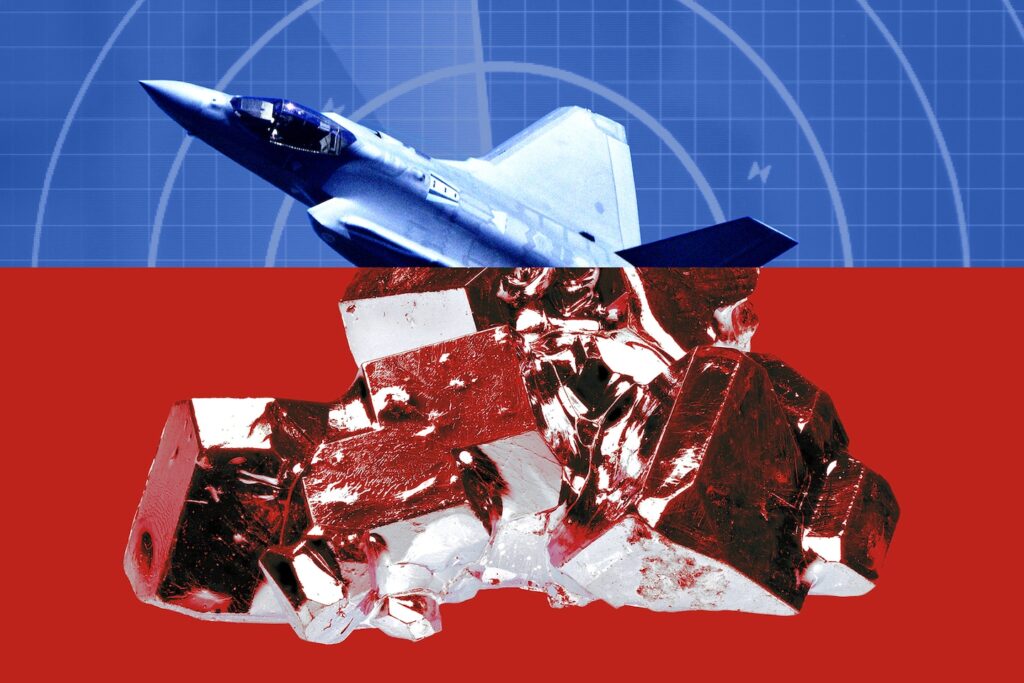
Imagine this: Advanced U.S. fighter jets flying overseas without the most up-to-date onboard radar. This scenario could play out because of a lack of an obscure but critical metal embedded in radars: gallium.
More than 300 new F-35 fighter jets are reportedly being delivered without their next-generation radars. Instead, they are leaving the factory with ballast weights in their nose cones — deadweight placeholders for a device the United States cannot currently source at scale.
In February, the Air Force denied this, but more recently Rep. Rob Wittman (R-Virginia), chairman of a House Armed Services subcommittee, acknowledged that the jets would be delivered with ballast.
The true advantage in modern military electronics stems from gallium nitride, a semiconductor that provides a 50 percent leap in capability for radars such as the F-35’s new AN/APG-85 radar over an older system that used gallium arsenide. Gallium nitride’s ability to handle significantly higher power and dissipate heat more efficiently allows for a new era of combat systems. This means radars that detect threats earlier, track an increased number of targets and operate robustly in jammed or contested environments. Gallium nitride condenses power into smaller, lighter systems. It is what enables advanced sensors in modern jets to spot hostile aircraft from afar, jam enemy radar and communicate securely.
Without a reliable supply of high-purity gallium, the Pentagon cannot build or sustain these technological advantages.
The U.S. produces zero unrefined gallium, whereas China accounts for 99 percent of global production. Beijing is exploiting this leverage by imposing export controls that inject market friction and uncertainty. China doesn’t need a perfect embargo; it only needs to create strategic drag to raise costs, slow production, increase investment risk and force compromises in the U.S. defense industrial base. Over 11,000 components in the Pentagon’s defense systems require gallium. With nearly 85 percent of those supply chains depending on a Chinese supplier, the defense industry is at risk.
While the U.S. struggles with integration and supply, China has fielded its own gallium nitride-based radars on its J-20 stealth fighters. This is what the gallium cliff looks like: a sudden threshold where stockpiles run dry and manufacturers face impossible choices.
This gallium shortage becomes even worse in the context of the Iran war. Iranian destruction of two major U.S. radars in the Middle East requires about 170 pounds of gallium to replace both systems. Repairing and replacing another 10 damaged radar systems and replenishing over 11,000 expended munitions creates an immediate demand for tens of thousands of pounds more. With the supply chain controlled by an adversary, meeting such a surge turns a tactical problem into a strategic crisis.
To understand how Beijing cornered the market, you have to understand how gallium is made. The metal is primarily extracted as a by-product of refining bauxite ore into aluminum. It is not geologically rare; the raw material exists in aluminum deposits all over the world.
So why does China control 99 percent of it? By 1987, American aluminum refiners had abandoned gallium extraction because the chemical process is expensive and environmentally toxic. Meanwhile, Beijing mandated gallium recovery for its subsidized aluminum industry. By flooding the market and driving down prices, China made it economically impossible for Western producers to compete. U.S. and European policymakers downplayed the threat, content to offshore the dirty, low-margin work to China, ignoring the long-term strategic risks. Today, that decision and complacency give China a chokehold on a metal essential to the U.S. economy and military.
There are signs of movement, such as the Energy Department’s TRACE-Ga initiative — a program funding technologies to extract gallium from domestic industrial waste — and other Pentagon investments in recycling firms such as Metallium. But these efforts are too small and slow for the scale of the problem. Moreover, the nation’s largest gallium deposit exists at the Sheep Creek project in Montana, but extracting substantial amounts of gallium and other important rare earth elements will still take a few years.
The U.S. government should intervene in the gallium market. Achievable goals to jump-start production include retrofitting industrial sites to capture gallium as a by-product. For example, the Atalco refinery in Gramercy, Louisiana, which is the last operating U.S. alumina refinery, is using federal backing to add a gallium recovery process. Meanwhile, the Korea Zinc smelter in Tennessee is being retrofitted to extract gallium and other minerals from electronic scrap by 2029.
Accelerating these efforts requires policies that encourage production through tax credits and streamlined permitting. It also requires the Pentagon to provide long-term agreements that would guarantee purchase contracts with companies to buy the finished metal each year. Finally, Washington should establish a stockpile of high-purity gallium, ensuring defense-critical systems and the commercial technology sector are insulated from foreign supply shocks.
The F-35 is meant to symbolize technological superiority — ensuring U.S. deterrence, stealthy first-strike capabilities and air supremacy. Yet, without a supply of gallium, its advanced radar cannot be produced at the pace required. And a fighter without its radar is just an overpriced airframe that should not be used in combat, turning the ultimate instrument of air power into little more than the most sophisticated parade float.